Mouth Ulcers: Causes & Care | EndoCare Dental Clinic, Viman Nagar Pune
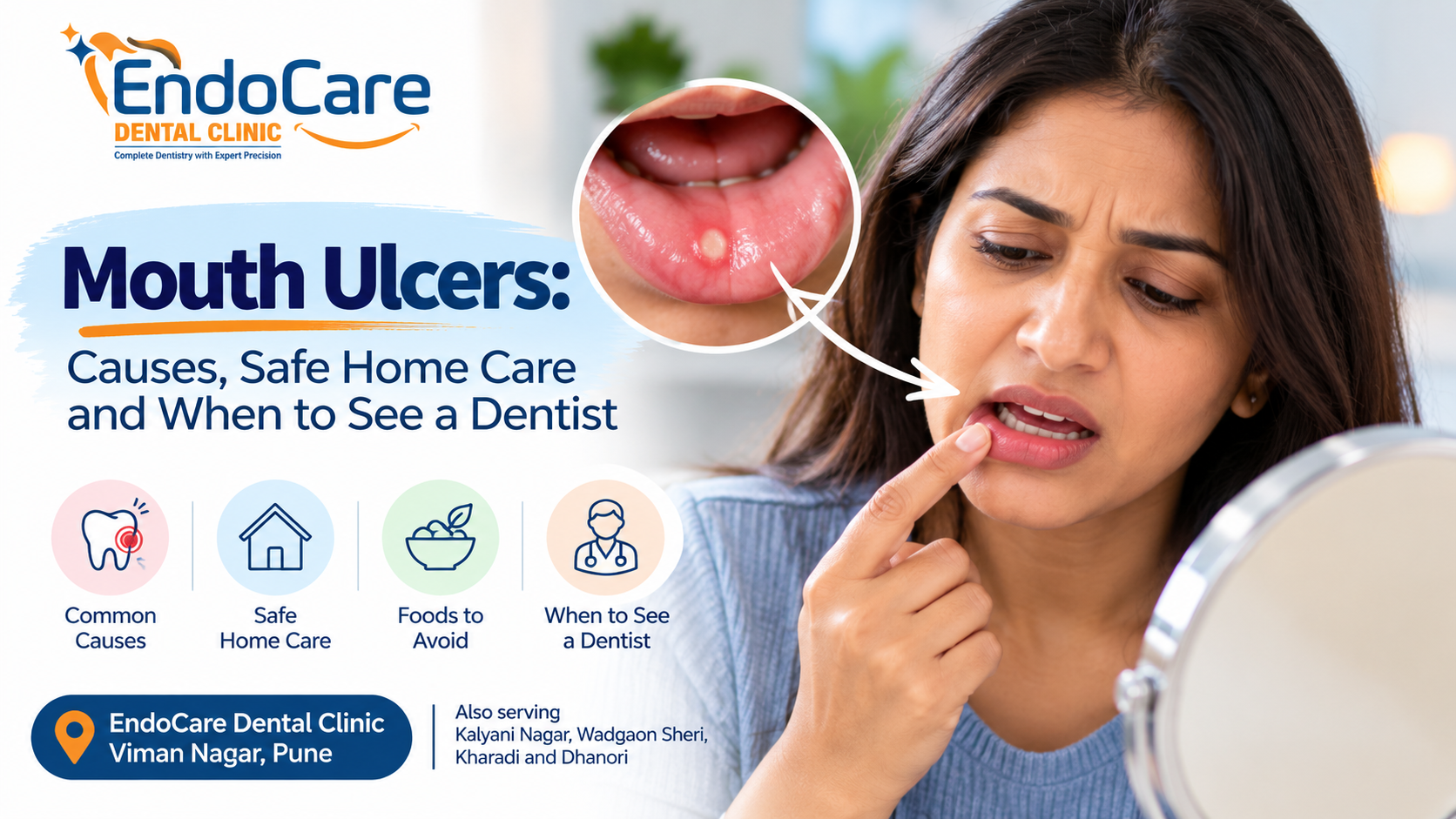
Mouth Ulcers: Causes, Safe Home Care and When to See a Dentist
Have you noticed a painful sore inside your cheek, on your tongue, along your gums or inside your lips? Mouth ulcers can make everyday activities such as eating, drinking, speaking and brushing your teeth uncomfortable.
Many common mouth ulcers heal on their own, but not every sore in the mouth has the same cause. Minor injuries, irritation from dental appliances, certain health conditions and other factors can produce similar-looking symptoms.
Knowing what may trigger a mouth ulcer, how to reduce irritation and when to seek professional advice can help you take the right next step.
If you live in Viman Nagar, Pune, or nearby areas such as Kalyani Nagar, Wadgaon Sheri, Kharadi or Dhanori, this guide explains what to look for and when a dental assessment may be appropriate.
Important: This article provides general oral-health information. It cannot identify the cause of an individual mouth ulcer or replace an examination.
In This Article
- What Are Mouth Ulcers?
- Common Causes of Mouth Ulcers
- How to Care for Mouth Ulcers at Home
- What Should You Avoid When You Have a Mouth Ulcer?
- How Long Do Mouth Ulcers Take to Heal?
- When Should You See a Dentist?
- Mouth Ulcers in Viman Nagar, Pune
- Frequently Asked Questions
What Are Mouth Ulcers?
A mouth ulcer is a sore that develops on the soft tissues inside the mouth. It may appear on the inner cheeks, inner lips, tongue, gums or roof of the mouth.
Common ulcers are often round or oval, with a pale centre and a red border. They may be painful when touched or irritated by food.
Some ulcers are isolated, while others appear repeatedly or in groups.
It is important to distinguish a typical canker sore from other mouth lesions. For example, cold sores commonly appear on or around the outer lips and are caused by a virus. They are different from ordinary canker sores inside the mouth. Cleveland Clinic
Are mouth ulcers dangerous?
Many common mouth ulcers are harmless and heal without specific treatment. However, the appearance of a sore alone cannot establish its cause.
A persistent, unusually large, frequently recurring or unexplained sore deserves professional assessment, particularly if it is associated with other symptoms.
Do not assume that every white or red patch in the mouth is an ordinary ulcer.
Common Causes of Mouth Ulcers
Mouth ulcers can develop for several reasons. Identifying a possible trigger may help you reduce irritation, but recurring or persistent ulcers should not be self-diagnosed.
1. Accidental biting or minor injury
Accidentally biting your cheek or tongue can damage the soft tissues and produce a painful sore.
Other possible sources of irritation include brushing too aggressively, sharp food edges or an injury during dental treatment.
A sore that develops after an injury should still be monitored to ensure it heals.
2. Irritation from braces, retainers or dentures
Dental appliances can sometimes rub against the soft tissues of the mouth.
A sharp edge, a poorly fitting appliance or repeated friction may cause localised irritation.
If you repeatedly develop sores in the same place where an appliance contacts your mouth, arrange an assessment. Do not attempt to bend wires, reshape appliances or modify dentures yourself.
3. Certain foods and drinks
Spicy, salty, acidic or very hot foods may aggravate an existing mouth ulcer.
Some people also notice that particular foods seem to trigger recurrent sores. Individual triggers vary, so it can help to note what you ate before a sore appeared.
Avoiding a food that consistently aggravates your symptoms may make eating more comfortable while the tissue heals.
4. Stress and other individual triggers
Some people experience recurrent canker sores during periods of stress or disrupted sleep.
However, stress is not the only possible explanation. Repeated ulcers can also be associated with nutritional deficiencies, infections, medication effects or other health conditions. Cleveland Clinic
If your mouth ulcers keep returning, a clinician can help determine whether further assessment is needed.
5. Underlying health conditions
Occasionally, recurring or persistent mouth ulcers are associated with a broader health problem.
Depending on the person's symptoms and medical history, a healthcare professional may consider nutritional deficiencies, inflammatory conditions or certain infections.
You should not begin vitamin supplements, antibiotics or other medication solely because you have mouth ulcers. The appropriate treatment depends on the cause.
6. Dental problems that repeatedly irritate the same area
A sharp or damaged tooth, a rough restoration or an appliance that rubs against the tissues may repeatedly injure the same part of the mouth.
If a sore keeps appearing in the same location, especially beside a tooth or dental appliance, have the area examined.
The aim is to identify and address the source of irritation rather than repeatedly treating the sore without investigating why it returns.
How to Care for Mouth Ulcers at Home
For a typical, minor mouth ulcer, simple measures may help reduce discomfort while the tissue heals.
These steps are for temporary symptom management. They do not replace assessment when a sore is persistent, recurrent or unusual.
1. Rinse gently with salt water
A gentle saltwater rinse may help soothe an irritated mouth.
Dissolve a small amount of salt in a glass of lukewarm water, rinse gently and spit it out. Do not swallow the solution.
Stop if the rinse causes significant irritation. Saltwater rinses are not a substitute for professional assessment of a persistent ulcer.
2. Use a soft-bristled toothbrush
Continue maintaining oral hygiene, but brush gently around the sore.
A soft-bristled toothbrush can reduce unnecessary friction on irritated tissues. Avoid scrubbing directly over the ulcer.
If brushing is particularly painful, ask a dentist or pharmacist about suitable ways to maintain oral hygiene while the area heals.
3. Choose foods that are comfortable to eat
Soft, cool or lukewarm foods may be easier to tolerate than hard or highly seasoned foods.
Consider temporarily avoiding:
- Very spicy foods.
- Acidic foods and drinks that sting the ulcer.
- Very hot beverages.
- Hard, sharp or crunchy foods.
- Foods that repeatedly trigger your symptoms.
You do not need to eliminate entire food groups without a reason. The objective is to reduce irritation while keeping yourself adequately nourished and hydrated.
4. Drink enough water
Drink water regularly, especially if pain makes you reluctant to drink.
If eating and drinking become difficult because of the ulcer, seek advice rather than allowing dehydration or inadequate food intake to develop.
5. Ask a pharmacist about suitable products
Some pharmacy products are designed to protect mouth ulcers or provide temporary relief.
The appropriate product depends on your age, symptoms, medical history and any medicines you already use.
Follow the product instructions and ask a pharmacist or healthcare professional if you are unsure whether a product is suitable for you.
Do not use prescription medicines left over from a previous illness.
6. Look for possible sources of repeated irritation
If the ulcer appeared after biting your cheek, using a new dental appliance or eating a particular food, note the possible trigger.
If a sharp tooth, broken restoration or appliance seems responsible, arrange a dental assessment. Do not try to file, bend or repair dental structures at home.
General mouth-ulcer self-care recommendations include gentle oral hygiene and avoiding foods that aggravate the sore. NHS Inform
What Should You Avoid When You Have a Mouth Ulcer?
Some well-intended home remedies may irritate the mouth or delay appropriate care.
Do not place aspirin directly on the sore
Holding a tablet against the ulcer is not a safe way to treat it and may injure the surrounding tissues.
If you need pain relief, ask a pharmacist or healthcare professional about an appropriate option.
Avoid applying harsh or unverified substances
Do not experiment with concentrated chemicals, household disinfectants or irritating substances on the ulcer.
Products intended for other uses may damage soft tissues.
Do not scrape or repeatedly touch the ulcer
Scratching or pressing the sore can cause further irritation.
Keep the area as clean as practical and allow it to heal without repeatedly disturbing it.
Do not self-prescribe antibiotics
Antibiotics are not a routine treatment for every mouth ulcer. They are appropriate only in selected circumstances when a healthcare professional determines that they are needed.
Taking leftover antibiotics without advice may expose you to unnecessary risks and fail to address the underlying problem.
Do not ignore a persistent sore
A sore that is not healing, keeps recurring or looks unusual should be assessed rather than treated indefinitely with home remedies.
The most important rule: If a mouth ulcer persists or repeatedly returns, investigate the cause instead of relying on temporary relief alone.
How Long Do Mouth Ulcers Take to Heal?
Many common mouth ulcers improve and heal within approximately one to two weeks. Healing time varies according to the type of sore, its size, the cause and whether the area continues to be irritated. NHS Inform
During this period, you can reduce discomfort by avoiding known triggers, maintaining gentle oral hygiene and protecting the sore from repeated injury.
However, there is no single healing timeline that applies to every mouth lesion.
When should you be concerned about the healing time?
Arrange an assessment if:
- The ulcer has not healed after three weeks.
- New ulcers keep appearing before older ones heal.
- The sore is unusually large or becoming more painful.
- The ulcer bleeds without an obvious reason.
- You notice a persistent red or white patch.
- You have a lump, persistent swelling or another unexplained change in your mouth.
- The sore interferes substantially with eating or drinking.
A mouth ulcer that lasts longer than three weeks needs professional evaluation because persistent sores can occasionally indicate a more serious condition, including oral cancer. This does not mean that every persistent ulcer is cancerous; it means the cause needs to be established. nidirect
When Should You See a Dentist?
A dental assessment may be appropriate when a mouth ulcer appears to be related to a tooth, restoration, denture or orthodontic appliance.
You should also seek professional advice if the ulcer is persistent, repeatedly returns or has features that concern you.
Arrange a dental or medical assessment if:
- The sore has not healed within three weeks.
- You frequently develop mouth ulcers.
- The ulcer is unusually large or worsening.
- A sharp tooth or dental appliance may be repeatedly injuring the tissue.
- You notice persistent red or white patches.
- You have unexplained bleeding, a lump or ongoing swelling.
- Eating, drinking or speaking has become difficult.
- You have other symptoms that suggest a wider health problem.
Depending on the findings, the appropriate professional may be a dentist, a doctor or an oral-medicine specialist.
What happens during an assessment?
A clinician may ask when the sore first appeared, whether it has happened before, whether it is painful and whether anything seems to trigger it.
The mouth and surrounding tissues can then be examined.
If the cause is not clear, or the appearance and duration raise concerns, further investigations or referral may be recommended.
Not every ulcer requires medication or a procedure. The appropriate next step depends on the findings.
Mouth Ulcers in Viman Nagar, Pune
If you have a mouth sore that repeatedly develops beside a tooth, denture or dental appliance, an examination can help determine whether local irritation may be contributing.
When looking for a dentist in Viman Nagar, focus on getting an appropriate assessment and a clear explanation of the next steps rather than assuming every sore has the same cause.
At EndoCare Dental Clinic, Viman Nagar, Pune, patients can discuss dental concerns and arrange a consultation when an oral problem may require dental assessment.
If your symptoms also involve swollen or bleeding gums, you can explore the clinic's Gum Treatment in Viman Nagar service information. Gum treatment is not a universal treatment for mouth ulcers; the appropriate care depends on the examination findings.
EndoCare Dental Clinic is located in Viman Nagar and serves patients from nearby areas, including Kalyani Nagar, Wadgaon Sheri, Kharadi and Dhanori. These are surrounding service areas, not additional clinic branches.
Book a Dental Consultation at EndoCare Dental Clinic
If you have a persistent sore, repeated irritation from a dental appliance or another dental concern, contact the clinic to discuss an appointment.
EndoCare Dental Clinic | Advanced Dentistry & Root Canal Specialist in Viman Nagar, Pune
- Phone: +91 90968 82602
- Hours: Open all seven days, 10:00 AM–9:00 PM
- Location: Viman Nagar, Pune
Contact EndoCare Dental Clinic to Book an Appointment
If a mouth sore is accompanied by significant difficulty swallowing, severe dehydration or other serious symptoms, seek appropriate urgent medical care rather than waiting for a routine dental appointment.
Frequently Asked Questions About Mouth Ulcers
1. What causes mouth ulcers?
Mouth ulcers can result from minor injuries, cheek biting, irritation from dental appliances, certain food triggers or other factors. Recurring ulcers can sometimes be associated with underlying health conditions. The cause cannot always be identified from appearance alone.
2. How can I heal a mouth ulcer faster?
Gentle oral hygiene, avoiding foods that irritate the sore, drinking enough water and using suitable pharmacy products may help manage discomfort. Many common ulcers heal naturally, but a persistent or unusual sore should be assessed rather than treated indefinitely at home.
3. Are mouth ulcers contagious?
Ordinary canker sores inside the mouth are not contagious. However, not every mouth sore is a canker sore. Cold sores, which commonly appear on or around the lips, are caused by a virus and can spread to others. Correct identification matters. Cleveland Clinic
4. When should I see a dentist for a mouth ulcer?
Seek professional advice if the ulcer is repeatedly returning, unusually large, worsening or associated with a sharp tooth or dental appliance. Any ulcer that has not healed within three weeks should be assessed by a healthcare professional.
5. Can braces or dentures cause mouth ulcers?
Yes. Friction or pressure from a dental appliance may irritate the soft tissues. If the same area repeatedly becomes sore, arrange an assessment to determine whether the appliance needs attention. Do not attempt to modify it yourself.
6. Can a mouth ulcer be a sign of a serious condition?
Most common mouth ulcers are harmless, but a persistent or unexplained sore can occasionally be associated with a more serious condition. A sore that lasts longer than three weeks, a persistent red or white patch, an unexplained lump or recurring bleeding should be professionally assessed.
Conclusion: Do Not Ignore a Mouth Ulcer That Will Not Heal
Mouth ulcers can make eating, drinking and speaking uncomfortable, but many common sores improve with time and gentle self-care.
Avoid repeatedly irritating the affected area, maintain oral hygiene and take note of any possible triggers. If the ulcer keeps returning, appears unusual or does not heal within three weeks, seek professional assessment.
For patients in Viman Nagar, Pune, and nearby areas such as Kalyani Nagar, Wadgaon Sheri, Kharadi and Dhanori, EndoCare Dental Clinic can be contacted for an appointment when a dental assessment is appropriate.
If you are concerned about a persistent mouth sore, arrange an assessment rather than relying on home remedies alone.
This article is for general educational purposes and does not replace an individual examination, diagnosis or treatment plan.
This article is general information from the EndoCare Dental Clinic team. It is not a diagnosis or a substitute for an examination by your dentist. Please consult a dentist for advice about your own teeth.