Deep Bite, Overbite and Underbite: Treatment in Viman Nagar, Pune
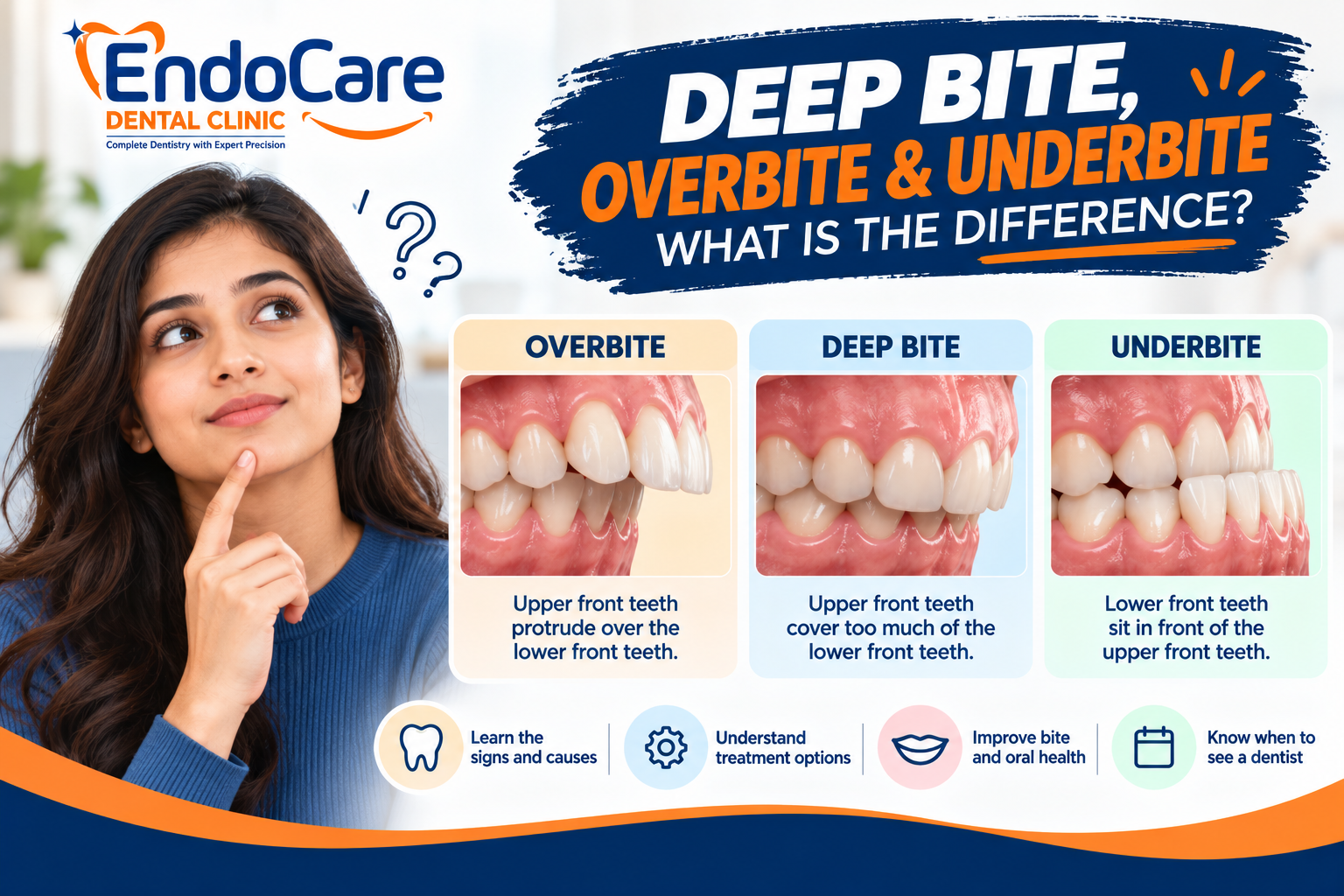
A certain amount of vertical overlap is normal. An overbite becomes a concern when the overlap is excessive or contributes to other dental problems.
What are the signs of an overbite?
Depending on its severity, an overbite may be associated with:
-
Upper front teeth covering a large portion of the lower front teeth.
-
Lower front teeth contacting the roof of the mouth in more severe cases.
-
Tooth wear or damage caused by an unfavourable bite.
-
Difficulty achieving a comfortable bite in some cases.
An overbite is not necessarily a problem simply because the upper teeth sit in front of the lower teeth. A dental professional needs to assess the amount of overlap and how the teeth function together.
2. What Is a Deep Bite?
A deep bite is a type of excessive vertical overbite. It occurs when the upper front teeth cover too much of the lower front teeth when the mouth is closed.
The terms deep bite and overbite are closely related, but they are not always interchangeable. Overbite describes the vertical relationship, while deep bite generally refers to an excessive amount of vertical overlap.
What problems can a deep bite cause?
A deep bite may contribute to:
-
Excessive wear of the front teeth.
-
Contact between the lower front teeth and the gum tissue behind the upper front teeth.
-
Tooth damage or gum irritation in more severe cases.
-
Difficulty achieving a comfortable bite.
Not everyone with a deep bite experiences symptoms. Some cases may simply be monitored, while others may benefit from orthodontic assessment and treatment.
How is a deep bite corrected?
Treatment depends on the amount of overlap, the position of the teeth, jaw relationships and the patient's stage of growth.
Depending on the individual case, treatment may involve braces, clear aligners or other orthodontic mechanics. More complex cases may require a specialist assessment and a broader treatment plan.
The appropriate approach cannot be determined from appearance alone.
3. What Is an Underbite?
An underbite occurs when the lower front teeth sit in front of the upper front teeth when the mouth is closed.
It may be related to the position of the teeth, the relationship between the upper and lower jaws, or a combination of both.
What are the signs of an underbite?
Possible signs include:
-
Lower front teeth extending in front of the upper front teeth.
-
A lower jaw that appears prominent.
-
Difficulty bringing the front teeth together comfortably.
-
Chewing difficulties in some cases.
-
Uneven tooth wear, depending on the bite.
An underbite can range from a relatively mild tooth-position problem to a more significant jaw discrepancy.
How is an underbite treated?
Treatment depends on whether the problem mainly involves the teeth, the jaws, or both.
Some dental underbites may be managed with orthodontic treatment. In growing children and teenagers, the timing of assessment may be particularly important because jaw growth can influence treatment planning.
A significant skeletal underbite in an adult may require a more comprehensive evaluation, and selected cases may need a combination of orthodontic treatment and corrective jaw surgery.
Braces or aligners alone are not suitable for every underbite.
Deep Bite vs Overbite vs Underbite: Key Differences
| Feature | Overbite | Deep bite | Underbite |
|---|---|---|---|
| What it describes | Vertical overlap of the upper front teeth over the lower front teeth | Excessive vertical overlap of the front teeth | Lower front teeth positioned in front of the upper front teeth |
| Is it always abnormal? | No; some overlap is normal | It refers to excessive overlap | It represents a different bite relationship |
| Possible concerns | Depends on the amount of overlap | Tooth wear, gum contact or discomfort in some cases | Chewing difficulties, tooth wear or jaw-related concerns in some cases |
| Treatment | May not be necessary | Orthodontic treatment may be considered | Depends on tooth position, jaw relationship and severity |
Important: These conditions can overlap with other bite problems. Only a clinical assessment can establish the diagnosis and whether treatment is recommended.
4. What Causes Bite Problems?
There is no single cause of deep bites, overbites or underbites. Several factors may contribute.
Genetics and jaw development
The size, shape and position of the jaws and teeth are partly influenced by inherited characteristics. Differences in jaw growth can contribute to certain bite patterns.
Tooth position and crowding
Teeth that erupt in unusual positions, crowding, or missing teeth can affect how the upper and lower teeth meet.
Childhood habits
Some prolonged oral habits during childhood may influence dental development. Their effects depend on the habit, duration and individual growth pattern.
Differences in jaw growth
The upper and lower jaws may grow at different rates or develop different relationships. This is particularly relevant when an underbite or another skeletal bite discrepancy is suspected.
A dentist or orthodontic professional can assess these factors and explain which ones appear relevant to an individual patient.
5. Do Deep Bites, Overbites and Underbites Need Treatment?
Not every bite difference needs correction.
Treatment may be considered when the bite affects chewing, causes repeated trauma to teeth or gums, contributes to significant tooth wear, or creates a functional concern.
In other cases, the main concern may be appearance or the patient's preference for improved tooth alignment.
An assessment helps establish:
-
Whether the bite is within an acceptable functional range.
-
Whether there is evidence of tooth wear or gum trauma.
-
Whether the problem involves tooth position, jaw position or both.
-
Which treatment options are realistic.
-
Whether monitoring or active treatment is appropriate.
It is important not to assume that every visible difference requires braces or aligners. Treatment should be based on the clinical findings and the patient's needs.
6. What Are the Treatment Options?
The right treatment depends on the type of bite problem, its severity, the patient's age, oral health and treatment goals.
Braces
Braces use brackets and wires to move teeth into planned positions. They can be used for many alignment and bite problems, although not every jaw discrepancy can be corrected with braces alone.
Clear aligners
Clear aligners are removable trays that gradually move teeth. They may be suitable for selected bite problems, depending on the movements required and the complexity of the case.
They must be worn as prescribed, and some cases may be better managed with fixed braces or a different approach.
Early orthodontic assessment for children
When a bite problem is identified in a growing child, an early assessment may help determine whether monitoring, interceptive treatment or later orthodontic care is appropriate.
Early assessment does not automatically mean treatment must start immediately.
Combined orthodontic and jaw treatment
Some significant skeletal discrepancies may require more than tooth movement alone. In selected cases, orthodontic treatment may be combined with corrective jaw surgery.
This decision requires appropriate specialist evaluation.
Retainers after treatment
After orthodontic treatment, retainers are commonly prescribed to help maintain the new tooth positions. The type and wearing schedule depend on the individual treatment plan.
7. When Should You See a Dentist for a Bite Problem?
Consider arranging a dental assessment if you notice:
-
Your front teeth do not meet comfortably.
-
Your lower teeth sit in front of your upper front teeth.
-
Your upper front teeth cover most of your lower front teeth.
-
Your teeth are wearing down unusually or becoming chipped.
-
You experience repeated gum irritation related to the way your teeth meet.
-
Your bite feels different or has changed.
-
Your child has a noticeable bite discrepancy.
If you experience significant pain, swelling or a sudden change in your bite, seek prompt dental advice rather than waiting for a routine orthodontic appointment.
Deep Bite, Overbite and Underbite Assessment in Viman Nagar, Pune
If you are concerned about your bite or tooth alignment, a dental assessment can help clarify what is happening and whether treatment is necessary.
At EndoCare Dental Clinic, Viman Nagar, Pune, patients can enquire about braces and clear aligner options. The appropriate treatment depends on an individual examination and treatment plan.
The assessment may include an examination of the teeth and gums, evaluation of how the teeth meet, and diagnostic records such as photographs, scans or X-rays when clinically indicated.
Patients visit the Viman Nagar clinic from nearby areas, including Kalyani Nagar, Wadgaon Sheri, Kharadi and Dhanori.
EndoCare Dental Clinic
Near Datta Mandir Chowk, Parijat Mithai Building, 1st Floor, Sai Apex, Viman Nagar Road, Pune, Maharashtra 411014.
Phone: +91 90968 82602
Hours: Open all seven days, 10:00 AM–9:00 PM.
Contact the clinic to discuss your concerns and arrange an assessment.
Frequently Asked Questions
1. What is the difference between a deep bite and an overbite?
An overbite describes the vertical overlap of the upper front teeth over the lower front teeth. A deep bite refers to an excessive amount of that overlap. A normal overbite does not automatically require treatment.
2. Is an underbite more serious than an overbite?
Not necessarily. The significance of either condition depends on its severity, its effect on chewing and tooth health, and whether the jaws or only the teeth are involved.
3. Can braces fix a deep bite?
Braces can correct many deep bites, depending on the cause and severity. The treatment plan may involve moving teeth in different directions to improve the bite. An examination is needed to determine the appropriate approach.
4. Can clear aligners correct an underbite?
Clear aligners may help manage selected underbites, particularly when the issue is mainly related to tooth position. Significant jaw discrepancies may need a different or more comprehensive treatment approach.
5. Should children have a bite problem assessed early?
Yes, a dental professional can assess a child's bite and advise on the appropriate timing of treatment. Early assessment may help identify growth-related concerns, but it does not mean every child needs immediate orthodontic treatment.
6. Can a bite problem cause tooth damage?
Some bite problems can contribute to uneven tooth wear, chipping or irritation of the gums. However, the risk varies by case, and not everyone with a bite difference develops these problems.
7. How do I choose the right treatment for a bite problem in Viman Nagar, Pune?
Start with a dental assessment. The clinician can evaluate your tooth positions, bite relationship, oral health and treatment goals before discussing suitable options, expected duration and follow-up care.
Conclusion
Deep bites, overbites and underbites describe different aspects of how the upper and lower teeth meet. While some bite differences are normal or do not require treatment, others may affect tooth health, chewing or comfort.
The right approach depends on whether the issue involves tooth position, jaw development or both. A professional assessment can help you understand your condition and make an informed decision about whether treatment is worthwhile.
If you are concerned about your bite, contact EndoCare Dental Clinic in Viman Nagar, Pune, to enquire about an assessment and available orthodontic options.
EndoCare Dental Clinic — Complete Dentistry with Expert Precision.
Medical disclaimer: This article is for general educational purposes only and does not replace an individual dental examination, diagnosis or personalised treatment advice.
This article is general information from the EndoCare Dental Clinic team. It is not a diagnosis or a substitute for an examination by your dentist. Please consult a dentist for advice about your own teeth.