Root Canal Treatment Cost in Pune: RCT, Re-RCT & Types Explained
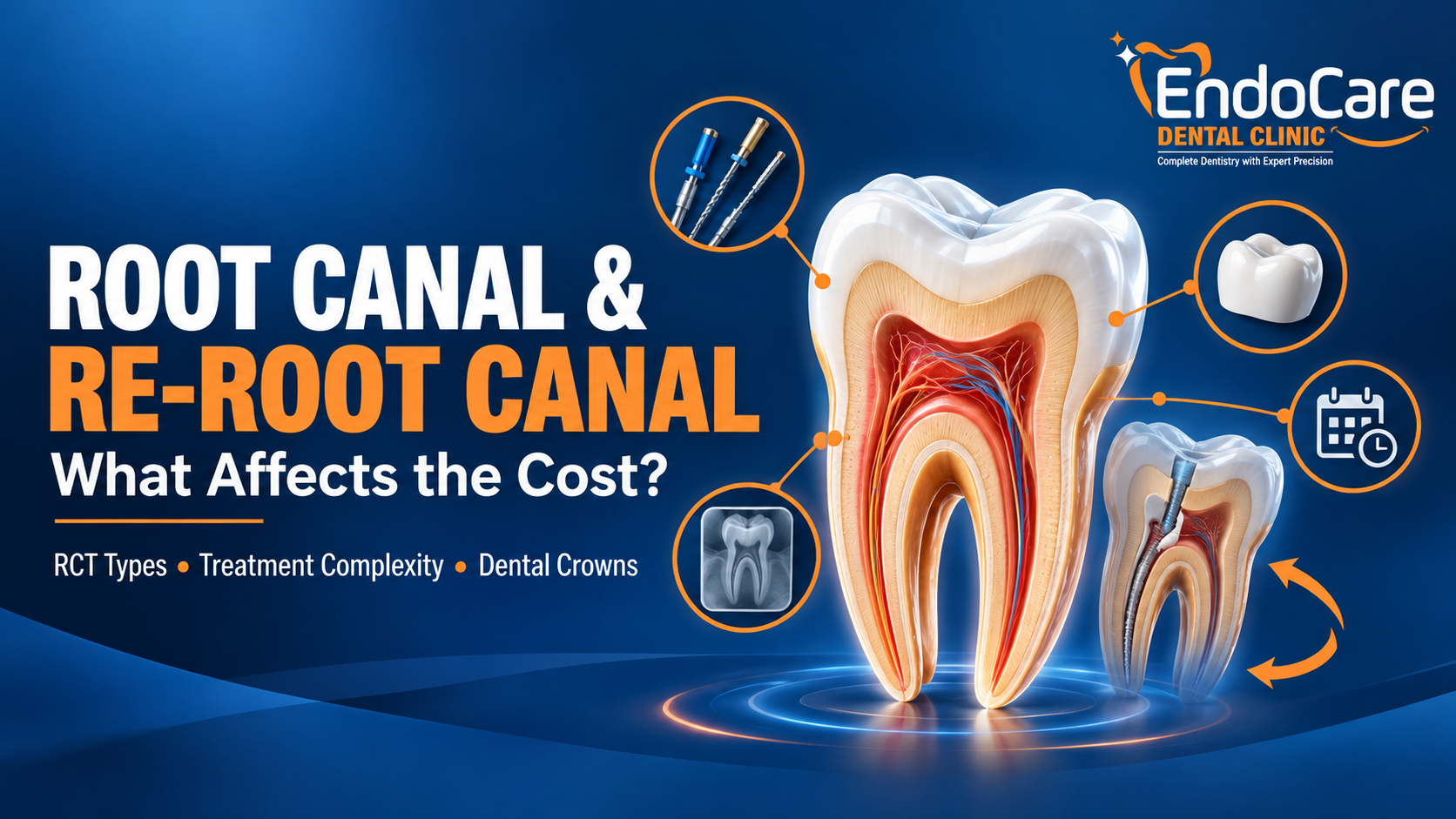
Root Canal Treatment Cost in Viman Nagar, Pune: Types of RCT, Re-RCT and Factors That Affect Pricing
If you have been advised to undergo Root Canal Treatment (RCT), you may be wondering what determines the cost and why the treatment fee differs between front teeth, premolars and molars.
Patients searching for Root Canal Treatment Cost in Pune often have additional questions. Is single-sitting RCT different from conventional RCT? Why can Re-Root Canal Treatment (Re-RCT) be more complex? Does the cost of RCT include a dental crown? And what should you consider before choosing a dental clinic in Viman Nagar?
The cost of root canal treatment depends on the tooth being treated, the number and complexity of its root canals, the extent of infection, the treatment technique and the restoration required afterward. A previously treated tooth that needs retreatment may involve additional clinical steps.
At EndoCare Dental Clinic | Advanced Dentistry & Root Canal Specialist in Viman Nagar, Pune, we believe patients should understand the treatment process and the factors that influence dental treatment costs before making an informed decision.
This guide explains the different types of RCT, Re-RCT, the cost factors associated with each procedure, and the additional dental treatments that may be required to restore a root canal-treated tooth.
In This Article
What Is Root Canal Treatment (RCT)?
Root Canal Treatment, commonly known as RCT, is a dental procedure used to treat a tooth when the pulp inside it becomes irreversibly inflamed, infected or damaged.
The dental pulp contains nerves, blood vessels and connective tissue. Deep dental decay, cracks, trauma or repeated dental procedures can damage this tissue and may lead to infection.
During root canal treatment, the dentist accesses the inside of the tooth, removes the diseased pulp tissue, cleans and shapes the root canals, disinfects the canal system and seals it with an appropriate filling material.
The tooth is then restored with a suitable permanent filling or dental crown, depending on the remaining tooth structure and clinical requirements.
The main aim of Root Canal Treatment in Viman Nagar, Pune, is to treat disease within the tooth and preserve the natural tooth whenever it can be predictably restored.
When Do You Need Root Canal Treatment?
A dentist may recommend RCT after evaluating symptoms and examination findings such as:
-
Persistent or severe toothache.
-
Prolonged sensitivity to hot or cold.
-
Pain while biting or chewing.
-
Deep dental decay reaching the pulp.
-
A cracked or traumatised tooth with pulp damage.
-
Swelling or an infection associated with the tooth.
-
Repeated dental procedures affecting the pulp.
These symptoms do not always mean that RCT is necessary. A clinical examination and appropriate dental X-rays help establish the diagnosis and determine the most suitable treatment.
What Are the Different Types of Root Canal Treatment?
The term RCT covers different treatment approaches. The appropriate technique depends on the condition of the tooth, canal anatomy, infection and complexity of the case.
1. Conventional Root Canal Treatment
Conventional RCT involves cleaning, shaping, disinfecting and sealing the root canal system. Depending on the clinical requirements, the dentist may use hand instruments, rotary instruments or a combination of techniques.
The treatment plan varies according to the tooth being treated and the complexity of its root canal anatomy.
2. Rotary Root Canal Treatment
Rotary root canal treatment uses motor-driven endodontic instruments to help clean and shape the root canals.
Rotary instrumentation can improve procedural efficiency in suitable cases. However, the dentist must still identify the canals, assess their anatomy, disinfect the canal system and seal it appropriately.
The choice of instrumentation depends on the clinical situation rather than a one-size-fits-all approach.
3. Single-Sitting Root Canal Treatment
Single-sitting RCT means completing the root canal procedure in one appointment.
It may be appropriate when the clinical findings, infection status, canal anatomy and treatment conditions permit completion in a single visit.
Not every tooth is suitable for single-sitting treatment. Some cases require additional appointments for medication, reassessment or other clinical reasons.
The number of visits should be determined by the dentist according to the patient's needs, not simply by the preference for a shorter treatment schedule.
4. Multiple-Visit Root Canal Treatment
Multiple-visit RCT involves completing the procedure over two or more appointments.
This may be appropriate when the tooth's condition, infection, canal complexity or treatment findings require a staged approach.
The number of appointments alone does not determine the quality of treatment. Appropriate diagnosis, cleaning, disinfection, sealing and final restoration are important considerations.
5. Re-Root Canal Treatment (Re-RCT)
Re-Root Canal Treatment, also called root canal retreatment, is performed when a previously treated tooth requires further endodontic treatment.
Re-RCT may be considered when there is persistent or recurrent disease following the original procedure. The dentist evaluates the reason for the problem and determines whether retreatment is feasible.
The procedure may involve removing existing root canal filling material, locating untreated canals, cleaning and disinfecting the canal system again, and resealing the canals.
Because these additional steps can make treatment more complex, Re-Root Canal Treatment in Pune may involve different costs from first-time RCT.
6. Surgical Endodontic Treatment
In selected cases, endodontic surgery, such as an apicoectomy, may be considered when conventional treatment or retreatment is insufficient or unsuitable.
This is a separate procedure from routine RCT and Re-RCT. It is recommended only after evaluating the tooth, surrounding tissues and other available treatment options.
Why Does Root Canal Treatment Cost Differ by Tooth Type?
One important factor affecting root canal treatment cost is the tooth that requires treatment. Front teeth, premolars and molars differ in their root canal anatomy and the complexity of treatment.
Front Teeth: Incisors and Canines
Front teeth often have relatively straightforward root canal anatomy, although variations occur.
The cost of treatment depends on the number of canals, the extent of disease and the restoration required afterward.
Premolars or Bicuspids
Premolars may have one or more canals. Variations in canal number and shape can influence the time and technical work required for treatment.
Molars or Back Teeth
Molars frequently have multiple canals, which may be narrow, curved or complex.
Locating and treating all the canals can require additional time and clinical expertise. Therefore, molar root canal treatment cost in Pune may differ from the cost of treating a front tooth.
The actual fee cannot be determined by tooth type alone. The dentist must assess the individual tooth and its clinical requirements.
What Factors Affect Root Canal Treatment Cost in Pune?
Patients searching for RCT cost in Pune may notice that treatment estimates differ between dental clinics. Several clinical and treatment-related factors can explain these differences.
1. Number and Complexity of Root Canals
The number of canals is important, but their shape and accessibility also matter.
Curved, narrow, calcified or unusually shaped canals can make cleaning, shaping and sealing more challenging.
2. Extent of Infection and Tooth Damage
The condition of the tooth and surrounding tissues can influence the treatment plan. Extensive decay, a crack, swelling or persistent infection may require additional assessment or procedures.
3. First-Time RCT Versus Re-RCT
A first-time root canal involves treating a tooth that has not previously undergone root canal treatment.
Re-RCT may require removal of existing filling material and management of complications associated with the earlier treatment. These additional steps can affect the complexity and overall fee.
4. Treatment Technique and Equipment
The instruments, materials and clinical protocol used for treatment can influence the procedure.
Hand instrumentation, rotary instrumentation and other techniques may be selected according to the tooth's anatomy and clinical needs. No single technique guarantees a successful outcome in every case.
5. Dentist's Training and Clinical Expertise
The clinician's training, experience and the complexity of the case may influence treatment planning and fees.
Complicated root canal cases and retreatments may require additional endodontic expertise.
6. Number of Appointments
Some cases can be completed in one visit, while others need multiple appointments.
The treatment estimate should clarify whether the quoted fee covers the planned procedure and any additional appointments or procedures.
7. Final Restoration After RCT
The total treatment cost may include more than the root canal procedure itself.
Depending on the condition of the tooth, the patient may require a permanent filling, core build-up, post and core, or dental crown.
This is an important consideration when comparing root canal treatment plans between clinics in Viman Nagar and other parts of Pune.
What Is Re-Root Canal Treatment (Re-RCT)?
Re-Root Canal Treatment is used when a previously root canal-treated tooth develops persistent or recurrent disease and further treatment may help preserve it.
Why Can a Previous Root Canal Fail?
Possible reasons include:
-
An untreated or missed canal.
-
Persistent infection within the root canal system.
-
Breakdown of the restoration that allows bacteria to re-enter.
-
Complex canal anatomy that makes complete treatment difficult.
-
New decay or damage affecting the tooth after the original RCT.
A tooth that hurts after RCT does not automatically need retreatment. The dentist must assess the cause of the symptoms and determine whether the tooth can be predictably treated and restored.
How Is Re-RCT Different From Regular RCT?
During first-time RCT, the dentist treats the root canal system for the first time.
During Re-RCT, the dentist may need to remove existing filling material, reassess the canals, identify untreated areas and address the reason for persistent or recurrent disease.
These additional steps can make Re-RCT more technically demanding.
Is Re-RCT Always the Best Option?
Not necessarily. The appropriate treatment depends on the cause of the problem, the amount of healthy tooth structure remaining, the presence of cracks and the feasibility of retreatment.
Depending on the findings, options may include nonsurgical retreatment, endodontic surgery or extraction. Your dentist should explain the benefits, limitations and implications of each suitable option.
Additional Treatments and Costs After RCT
When comparing the cost of root canal treatment in Viman Nagar, Pune, it is important to understand which restorative procedures may be required after the root canal is completed.
1. Dental Crown or Cap After RCT
A dental crown covers and protects the tooth. It may be recommended when the remaining tooth structure requires additional protection, particularly for many back teeth with substantial structural loss.
Common crown options include:
-
Metal crowns.
-
Porcelain-fused-to-metal (PFM) crowns.
-
Full zirconia crowns.
-
Other suitable ceramic or aesthetic crowns.
The choice depends on the tooth's location, the amount of remaining tooth structure, chewing forces and aesthetic requirements.
Not every root canal-treated tooth needs a crown. Your dentist should recommend the appropriate restoration based on the individual tooth.
2. Core Build-Up or Post and Core
If significant tooth structure has been lost due to decay, fracture or previous restorations, the tooth may need to be rebuilt before a crown is placed.
A core build-up reconstructs missing tooth structure. In selected cases, a post may be used to retain the core when insufficient tooth structure remains.
A post is not required in every RCT case, and its use depends on the clinical condition and planned restoration.
3. Consultation and Dental X-Rays
An initial dental consultation helps establish the diagnosis and determine whether RCT or Re-RCT is appropriate.
Dental X-rays may be required to assess the roots and surrounding tissues, evaluate previous treatment and plan the procedure. Additional imaging may be considered in selected complex cases.
Ask whether consultation charges, X-rays and any additional investigations are included in the treatment estimate.
4. Temporary and Permanent Fillings
A temporary filling may be used between appointments or while the final restoration is being planned.
Once the root canal is completed, the tooth needs an appropriate permanent seal and restoration. The estimate should clarify which filling procedures are included and whether any additional restoration is required.
5. Additional Procedures for Complex Cases
Some teeth require additional procedures because of extensive decay, complex canal anatomy, previous restorations or complications associated with earlier treatment.
The dentist should explain why any additional procedure is recommended and how it affects the overall treatment plan.
How to Compare Root Canal Treatment Plans in Pune
Before choosing a dental clinic for RCT or Re-RCT, compare the complete treatment plan rather than considering only the initial procedure fee.
Ask your dentist:
-
Is the treatment for a front tooth, premolar or molar?
-
Is it a first-time root canal or Re-RCT?
-
How many visits are likely to be required?
-
Are consultation, X-rays and fillings included?
-
Will a dental crown, core build-up or post and core be needed?
-
Are additional procedures charged separately?
-
What are the available treatment options for my tooth?
A clear estimate helps you understand what is included and why the recommended treatment is appropriate for your condition.
The lowest initial fee does not necessarily represent the lowest overall treatment cost. Similarly, a higher fee should be accompanied by a clear explanation of the procedures and services included.
Root Canal Treatment in Viman Nagar, Pune at EndoCare Dental Clinic
At EndoCare Dental Clinic | Advanced Dentistry & Root Canal Specialist in Viman Nagar, Pune, root canal treatment is planned according to the individual tooth, its condition and the patient's treatment requirements.
Dr. Mugdha Bichile Pimplapure (BDS, MDS), Conservative Dentist and Endodontist, provides root canal care with an emphasis on preserving natural teeth whenever clinically appropriate.
Treatment planning involves evaluating the tooth, its root canal anatomy, the extent of infection and the restoration required afterward.
Whether you need first-time Root Canal Treatment, single-sitting RCT where clinically suitable, or Re-Root Canal Treatment for a previously treated tooth, a consultation can help you understand the available options and expected treatment components.
EndoCare Dental Clinic serves patients looking for dental care in Viman Nagar and nearby areas of Pune, including Kharadi, Kalyani Nagar, Wadgaon Sheri and Dhanori.
Looking for Root Canal Treatment in Viman Nagar, Pune? Contact EndoCare Dental Clinic to discuss your symptoms, understand your treatment options and receive an individual treatment estimate.
Frequently Asked Questions About Root Canal Treatment and Re-RCT
1. What determines Root Canal Treatment cost in Viman Nagar, Pune?
The cost depends on the tooth being treated, the number and complexity of canals, the extent of infection, the technique used and the restoration required afterward. An examination and appropriate dental X-rays help determine the treatment plan.
2. Why can molar RCT be more complex than front-tooth RCT?
Molars frequently have multiple canals, which may be curved or difficult to locate. Treating the complete canal system can require additional time and technical expertise compared with many straightforward front-tooth cases.
3. What is the difference between RCT and Re-RCT?
RCT is the first root canal treatment performed on a tooth. Re-RCT is retreatment of a previously treated tooth when further endodontic treatment is required to address persistent or recurrent disease.
4. Is single-sitting RCT suitable for every tooth?
No. Single-sitting RCT may be appropriate when the clinical condition permits completion in one appointment. Some teeth require multiple visits depending on infection, anatomy and treatment findings.
5. Does root canal treatment include a dental crown?
Not always. The RCT procedure and final restoration may be separate components of the treatment plan. Ask whether a permanent filling, core build-up, post and core or crown is included in the estimate.
6. Does every root canal-treated tooth need a cap?
No. The need for a crown depends on the amount of remaining tooth structure, the tooth's position and the forces it must withstand. Your dentist can recommend the most appropriate restoration after assessing the tooth.
7. Can a previously treated tooth undergo Re-Root Canal Treatment?
Yes. Some previously treated teeth can undergo Re-RCT when the cause of persistent or recurrent disease can be addressed and the tooth can be predictably restored. The decision requires a clinical examination and suitable imaging.
8. How many visits are needed for Re-RCT?
The number of visits depends on the complexity of retreatment, the condition of the tooth and the treatment plan. Some cases may be completed in one appointment, while others require multiple visits.
9. Is root canal treatment painful?
Local anaesthesia is used to help control pain during treatment. Some tenderness or discomfort may occur afterward, especially when the tooth was inflamed or infected before treatment. Your dentist can explain what to expect and how to manage discomfort.
10. Should I choose tooth extraction instead of Re-RCT?
The decision depends on whether the tooth can be predictably retreated and restored, the likely outcome, and the implications of extraction and tooth replacement. Discuss the suitable options with your dentist before deciding.
Conclusion: Understand Your RCT Treatment Plan Before You Begin
Root Canal Treatment cost varies because teeth, canal anatomy and clinical requirements vary. Re-RCT may involve additional technical steps, while the final restoration can also influence the overall treatment plan.
Understanding the differences between conventional RCT, rotary RCT, single-sitting RCT, multiple-visit RCT and Re-Root Canal Treatment helps you ask informed questions and compare treatment options.
If you are looking for Root Canal Treatment or Re-Root Canal Treatment in Viman Nagar, Pune, an examination-led consultation at EndoCare Dental Clinic can help you understand the condition of your tooth, the appropriate treatment approach and the restorative care you may need afterward.
EndoCare Dental Clinic, Viman Nagar, Pune — specialist-led dental care focused on preserving your natural teeth whenever clinically possible.
This article is general information from the EndoCare Dental Clinic team. It is not a diagnosis or a substitute for an examination by your dentist. Please consult a dentist for advice about your own teeth.